Monday, June 4, 2012

Victory Day

Guided only by gestures and nods of agreement as answers to my pointing down the road and asking “Jumati Monastery?”, I hoisted up my backpack and made my way up the road everyone seemed to indicate. Having begun my assent up the small dirt road, I paused, my attention captured by a large grey slab enclosed in a fence bearing the numbers 1941-1945 and the pictures of 20 men, presumably Georgians who had gone and fought or perhaps died in the war. I thought to myself that it was especially apt that I chose that day, May 9, of all days to walk that path by that memorial on my way up to the monastery, as for Georgians May 9 is “Victory Day,” the day of celebrating victory in WWII. I also could not help but notice the freshly cut flowers in a vase made out of half a two-liter bottle that had been placed in commemoration of the day, giving a splash of life to that monument that seemed otherwise neglected. Little did I know that that splash would soon become a sea, and that it would become clear the gravity people attribute to that day.

Scorched by an unusually hot May day, I was glad when my path soon changed from an open, exposed road to a small wooded trail leading higher into the hills of Guria. I remember the shift vividly; the road, lined by fields and planted trees came to a gate beyond which beckoned the small wooded path, surrounded by forest with only the intermittent overgrown orange grove giving any indication of human interference. The botanist in me perked up, and I immediately prepared myself to document everything I saw, avowing to take field notes and photo documentation of the flora I encountered. I was not disappointed. I had arrived in time to see the end of the blooming of the azaleas, bright yellow in color and emitting a thick, nectary smell that imbued the air simultaneously with a refreshing sweetness and a heaviness. I had also come in time to see the Pontic Rhododendrons in full bloom, proudly displaying their masses of purple flowers, enticing pollinators and admirers alike. These shrubs, flanked along the ground by a host of wildflowers both familiar and unfamiliar were embedded in a forest matrix that consisted largely of chestnuts. Seeing a true chestnut forest piqued my imagination in a way that few forests have the power to, for it seemed to be a hint at what my beloved forests of the Southeast US may once have been. I will never see the chestnut-dominated forests of the Southeast before the chestnut blight hit, but I now have the image of a Caucasian forest, otherwise very similar in composition, that can provide me some indication of what it would have been like to see those long, serrated leaves blotting out the sun above and the ground strewn with the discarded hulls of last year’s mast.

Walking in those woods had a strange effect on me. While as of late every spare moment I have to sit and think seems to be dominated by thoughts of home, plans and dreams of life back in America, in those woods, cataloguing those plants I was completely engrossed in the moment, in that place. While I was making comparisons of one forest to another, I was not doing so out of a longing for my own home, but out of a curiosity, a desire to know this place as I know the home I have left behind. As of late I find myself divided in two, being pulled toward two opposite poles; on the one hand is the place where I am, the regions of Georgia I have left unexplored and the knowledge that the time I have remaining to experience life here is dwindling, but on the other hand I find my mental states already drawn back to being home, planning meals I will eat, friends I will see, places I will go, and projects I will start. This latter pole constantly threatens to take me out of the moment, to transport me beyond the present and prevent me from living each successive moment in its fullness, but on this trip to the Jumati Monastery I found myself drawn completely in the opposite direction. I was fully engaged and embedded in my surroundings, doing everything I could to take in the views over the valley below, the smell of the flowers, and the feeling of being alone on a hike, free to focus only on the natural landscape around me.

And so, despite warnings of the wolves that roam the woods and the likelihood of not finding the monastery amidst old paths intersecting the right one, I pressed on, confident in my ability to reach my destination. I trudged on in a flora-induced stupor, noting everything I saw, puzzling over unfamiliar trees and flower forms, looking up from the greenery only to catch glimpses of the view over all of Guria unfolding before me. Though a cloudy day, the view was still impressive, and became even more so as I neared the top of the path and the monastery awaiting me at the top.

After eight or nine kilometers of hiking my path opened up and met a road leading me the rest of the way to the top of the mountain, and after a ways this road yielded my first glimpse of the cross adorning the top of the church. I was amazed by the quietude of the place; there was not a soul in sight, only an old church standing formidably yet invitingly atop the hill, enticing weary pilgrims with its cool stone interior and magnificent views of the lush valleys below. And so I made my way up the hill, crossed myself in Orthodox fashion and entered the church. Standing on the thresholds of Orthodox churches I never know what to expect when I enter. My reactions range from being awe-struck by waves of reverence and the holiness that seems to emanate from the stones, icons, candles, and the very make-up of the interior space to an emotionless respect for the way the structure is built, icons are painted, etc. On this occasion, whether a product of the long hike to reach it, the beauty of the setting, or something more metaphysical, my reaction decidedly fell into the former category. I was captured by the flicker of the two candles lit in front of icons, the flaking frescoes dating back an unknown number of centuries, the simplicity of the icons, and the pervasive holiness of the place. I slowly made my way around the icons, allowing each of the figures, familiar or not, to serve as a vehicle or catalyst for prayer, directing my thoughts to the history of the church, the men and women who exemplified its mission in their own way, and the lessons they could teach me and others in our contemporary world about living by what is most important rather than most expedient, and through it found myself praying for the state of the world as well as the specific concerns that gripped me in the moment.

My solitude in the church was only broken by the appearance of a novice monk who walked in, immediately making his way around the church, reverencing icon after icon, paying special attention to the case of bones sitting in front of the iconostasis, a case I would later come to find holds the remains of monks from the 16th century, killed by a Turkish invasion and made saints to the monks of that monastery. On a day devoted to the memorial of those who have gone on before us and those who fought for something greater than themselves, this seemed an exceedingly appropriate gesture.

While I was no longer alone in the church, the monks presence was no break to my solitude; in fact, his calm demeanor, long dark beard, and distinctly Georgian features seemed so at home in that sacred space that the wave of holiness that first struck me seemed more complete. We did not acknowledge each other in the church, but soon both made our way out, stepping out once again to the view of Guria. It was there we began talking, communicating in Russian, exchanging everything from the basic pleasantries and the “how long have you been in Georgia?” and “Have you not learned any Georgian?” questions, to more probing ones about life in the monastery and the different types of people who arrive at the monastery, this latter topic inspired by the loud and irreverent group of Georgians down below on an excursion that seemed to have little to do with the holiness of the place. We sat together for over half an hour intermittently conversing and sitting in silence, and though we talked little of faith (other than him asking me if I was Orthodox), I left with the sense that this aspiring monk had a deep faith about him, and represented a lot of the traits that I inspire to embody. He left me with a token of that meeting, a small cross he carved out of plastic, that though no technical masterpiece is one of the greatest physical objects that I will take away from Georgia, as for me it is a symbol of some of my favorite things about this country, the warmth and love of a people eager to invite in and give to anyone who shows up on their doorstep and a sense of pride in the history and faith they have maintained and fought for for centuries.

Christianity in Georgia is a story of great perseverance, as throughout its history the small population of Georgians occupying a major crossroads between Europe and Asia has been under attack from all sides; Turks, Mongols, Russians have all swept in and found great resilience amongst the Georgian people. And the Jumati Monastery itself bears evidence of this struggle. The great martyrs of the 16th century are just part of a lineage of resilience and perseverance within the faithful of that place. The monastery was closed during the Soviet Union, and all of the monks imprisoned or killed, yet out of the rubble of the USSR’s collapse the place and the community was resurrected. That cross I was given bears within it the mark of these stories; it is a sign of the ability of a faith community to survive and weather out wave after wave of attack and come back stronger and more vibrant than it could have been if allowed to go unchallenged.

Rejuvenated by my time atop the mountain and a few final prayers in the church, I began my way back down to the main road, enjoying the fading of the afternoon’s heat and the golden glow of the early evening. As I neared the spot of the monument I had taken note of earlier, I saw that the former emptiness and abandonment that had only been punctuated by one solitary gift of flowers earlier was now a distant memory. I rounded the corner and saw the dilapidated picnic table surrounded by men and women of three or four generations, with the table piled high with typical Georgian fare: cornbread and farmers’ cheese, onions and cucumbers fresh from local gardens, hardboiled eggs soaked in tqemali sauce (a spicy condiment made from sour plums, garlic, and other spices), and the ubiquitous staple of the Georgian table: khachapuri (bread baked with a thick layer of freshly made local cheese). I was instantly touched by the gesture; it was refreshing to see that the people of this village did not deem Victory Day a day to be remembered with a single bouquet of flowers, but that something much more substantial had coalesced on that day.

As I passed the gathering, I soon received the wave and call to join the table that I had a strong inkling was to come. I soon found myself the ward of a man named Amerigo, whose nice clean Russian was a pleasant break from the often rough, difficult to understand language of many Georgians in the villages. He led me to the table, sat me down, encouraging me to eat everything in sight, and took it upon himself to serve as my translator. The spot I had been given at the table, right next to the tamada (toastmaster), was a prime position, one I felt unworthy of, as there were far more people gathered than could immediately fit around the table. Soon after arriving, the tamada caught me up on what I had missed, offering a series of three toasts, all dedicated to those who fought in WWII, though each toast represented a progression and addition onto the last. As he gave the first toast, my guide explained to me that twenty men had left from their small village to fight in WWII, some of them not returning, and that the monument I had noticed earlier was in memory of those brave souls. That first toast was to those men, and to the role they served in the War. The second commemorated not only those who left for the war, but was given in honor of the annual ritual I had stumbled out of the woods upon, that men have been gathering for generations to remember those who fought for freedom, and for the hope that the tradition would continue for years to come and that future generations will not go through life ignorant of their past and their ancestors.  The third and final toast on the theme was not only given for the men who fought from that village or even just those from Georgia, but to all of those who fought the forces of fascism for the sake of freedom and to the connections, friendships, and unity that existed between people of different nationalities and backgrounds, united by one common cause.

I was struck by the profundity and thought that was put into these toasts. Sometimes I find the Georgian tradition of toasting frustrating, especially when it is administered by an uninspired toastmaster who seems to be mechanically running through a list of set toasts out of tradition’s sake just as a pretext for drinking glass after glass of wine. But it was clear that this occasion meant more to those gathered around the table than a pretext to drink homemade wine and eat great food. The way that the toasts progressed, with man after man around the table expounding upon and adding to each, it was clear that they were genuinely proud of the heroes their village produced, and held a sincere belief in the importance of remembering one’s ancestors and preserving that memory for future generations. Though this was a decidedly more secular celebration than my time at the monastery had been, I could not help but think that the importance each group—the monks and the feasters—assigned to the past, especially to the past of the place they inhabited, was one in the same. The novice monk’s long pause and intentional reverence of the bones of the martyrs and the offering of drink after drink of wine, a great gift given from the earth, in memory of all who served in the war were closely parallel and interconnected acts. Both sought to honor those who have gone before us, and those who can inspire us, teaching us lessons of how we should live our own lives, standing up to opposition and not backing down in the face of adversity. The monk and the feasters were both reverencing people who had stood up for what they believed in, who had sacrificed themselves for an ideology greater than themselves, and it was clear that they felt empowered by these examples of the human will going beyond the finite limits of individual wants and needs. If there is one thing that will stick with me from that day, it is the need to honor and acknowledge those who sought something greater, who saw that there are things much greater than ourselves that are worth sacrificing everything for. And perhaps the people they were honoring that day, the 16th century monks and the WWII soldiers were not sacrificing themselves for such different ideals. I can’t say exactly what drove those twenty young men to fight against fascism, but I imagine it must have something to do with a belief that man should be able to exist free from oppression; and likewise, the monks were fighting for their faith, a faith through which, in their minds, man is able to attain true freedom, the freedom of being reunited with God in eternity, breaking free from the oppressive limits of our temporal existence.

I will remember that monk and those generations of men gathered around that table, and the gravity they assigned to honoring our past for the sake of leading us to a brighter future. We have days to remember the past in America, days dedicated to veterans, presidents, other major figures, Memorial Day, and, of course, Independence Day, but I have never seen them assigned the importance that those Georgians gave to remembering those who have gone on before them. Too often the meaning or reason for our holidays are obscured by the layers of celebration added atop them: Memorial Day becomes about the beginning of summer, firing up the grill, and spending a day out in the sun and the Fourth of July similarly becomes more of a fireworks display and barbeque than a reason to look at our nation’s history and apply what its founding means in terms of our own lives and the lives of others around the world.

At a time when I had become somewhat disillusioned with many aspects of Georgian culture and Georgian traditions, seeing that celebration of the past and the thoughtful and insightful exploration of the meaning of Victory in WWII, undertaken by the men of a small village from different generations was a refreshing experience. And on top of everything else, the fact that they were willing to draw me in, take the time to explain each toast to me, and offer the fruits of their labors for me to eat and drink helped to remind me of why I fell in love with this country and this people early on in my year of teaching here. Being there with those men, like the trip to the monastery that preceded it, helped snap me out of my persistent looking ahead to a time when I will no longer be in Georgia and to just appreciate the present moment, reveling in the wealth of new and constantly replenishing experiences I have had and continue to have here.
And so, after a few cups of wine so generously given and toasts so eloquently said, Amerigo turned to me and asked, “Maybe you’ve had enough and are ready to go?” This was not a statement of “you’ve drunk enough of our wine and we’re ready to get rid of you,” but was yet another extension of hospitality. Whereas many Georgians are insistent on you staying with them, drinking glass after glass while they play “watch the American get drunk off our wine,” Amerigo and those men wanted to make sure I was comfortable, and left the decision of how much I had and how much I wanted up to me. Amerigo had guessed right, and I was not looking to drink more than the four or five toasts I had heard, and so I told him I would be walking off on my way. But with another gesture of hospitality, Amerigo told me he could not let me do that, and that he would be driving me the 8km to the main road where I could find a marshutka home.
This ride home proved to be more than a nice gesture, and yielded one of the most interesting conversations I had that day. As Amerigo began the drive, he asked me if I recognized his name and knew who he was named after. I searched the recesses of my memory for facts learned in high school geography classes, and in mediocre Russian tried to explain Amerigo Vespucci’s discovery of America. My new friend Amerigo then added a few details, and quickly launched into the tale of how he came by his name. Upon meeting him I had not thought about the oddity of his name, but as he was about to launch into his tale, it occurred to me that in Georgia, a place where the same 8-10 names (Giorgi, Luka, Nika, Ilo, Dato…) are repeated time and time again, to come across a man named Amerigo is a highly unusual occurrence. The story of how he got his name proved to be as interesting as the name is out of the ordinary.

Apparently, as Amerigo’s mother was pregnant and only a few weeks away from his birth, she had a dream that was simultaneously scary and portentous. She saw herself in the midst of a great battle (a fitting setting for a story delivered on this Victory Day), surrounded by soldiers of various nationalities, including a number of Americans. In the midst of her trembling in fear at the prospect of being stuck in this battle scene, Amerigo’s mother saw one of these Americans turn to her, grab her and say to her with an expression of grave seriousness “You will name him Amerigo.” The soldier then turned and went back to fighting the enemy. She awoke with this dream replaying over and over in her mind, and was unable to shake the look and the words of that soldier, and vowed that if indeed she did have a son, she would name him Amerigo. Sure enough, shed had the son, and that is how my new friend got his name.

To me this story is not a funny tale of an absurd account of a woman taking something she heard in a dream way too seriously, but is a look into the way that Georgians have maintained an adherence to the importance of signs and symbols in their lives. What other cultures may have discarded as anachronistic or superstitious, Georgians have maintained in their cultural consciousness. Sure this leads to some ridiculous beliefs like one I heard the other day that drinking water when you are hungover leads to heart attacks, but in many other ways, I think there is a lot to be said for a continued adherence to ritual and the importance of signs and symbols in one’s life. So much of Western culture is dominated by materialism and rejection of mystery; we try to fundamentally see the world as a series of knowable causes and effects, viewing every experience as a solitary event without imagining it as having greater significance in our own lives or implications that extend well beyond us. We look to narrow sets of causes rather than seeking the origins of occurrences in forces out of our control or perhaps forces completely unknown to us. While I don’t advocate turning to practices like astrology and seeking to ascertain the origin of every twist of fate in the motions of the stars and the planets, I think there is a way to healthily reincorporate a sense of mystery in the way we view the world. Every event, every decision we make, every drop of experience we come in contact with is part of a chain of myriad causes. While we think we can delineate and describe those causes, ultimately the scope of them is beyond us, and at some point it is necessary to acknowledge that we are limited and fallible in our knowledge, and with that we must take things as they are and know that we cannot know the full significance of events. Amerigo’s mother did not try to reduce her dream to something purely mechanical, a firing of neurons and just a vision to be ignored, but left open the possibility that forces greater than herself were at work, that what brought about that dream was unknowable, and in her humility could do nothing other than to obey the command of that soldier. By obeying that command she left open to herself the possibility of a world beyond human reason, beyond our understanding, a world of mystery in which every experience exists with a significance far greater than anything we can imagine or understand. She had no warning or reason to suspect there would be any consequences associated with disobeying the voice, with giving her son a name like Nika, Giorgi, or Luka, but I imagine she felt that to do that would be to close off a universe of possibility.

While I don’t know how my time in Georgia will change me and who I will be after this experience, I hope I can take something from the people of this country in terms of the way they leave those possibilities of a world of mystery beyond our grasp open. There is much to be learned from an attitude that believes wholeheartedly in the necessity of crossing oneself every time you pass a church, in naming your children based on the command of an ephemeral figure in a dream, or in the tangible reality of guardian angels that go with all of us through our lives. To reject these as silly superstitious and to instead put full faith in what is objectively demonstrable and measurable or rooted in purely material causes is to limit oneself to a narrow view of the world, to shut out a world of potentialities and possibilities in which each action, each turn of fate has a significance that extends out into the universe, beyond the grasp of our understanding, and that has an unquantifiable impact on our lives.

I don’t know the full implications of what a worldview maintaining a healthy sense of mystery has for me; it is a notion that I have been grappling with for a while. I’m sure I am doing a poor job of explaining what I have come to believe on the subject, but I sincerely hope that as I move on from Georgia I will remember my time here, remember these people, and through reflection on these experiences be able to draw closer to a robust, well-rounded view of the world that can draw connections between disparate experiences, but that can also be content with disconnects, with gaps that cannot be filled but that can only be acknowledged as fundamentally mysterious.

The greater meaning of the gift of a cross from a chance meeting with a monk, a supra commemorating factory in a war for the preservation of human freedom, and a chance meeting of a man named by the voice of an American soldier in a dream, eludes me at the moment, and I’m sure will continue to elude me, but I cannot let that mean it all has no greater meaning. I cannot deny the possibility that those events, that journey to the Jumati Monastery could have a significance for me in my life and a set of consequences that extend far beyond what I can describe or understand. All I know to do at this point is to cherish those memories, to remember the interactions, feelings, and thoughts I had on that day, and to continue to use all of the new experiences I go through in my life to look back on those moments and to think both about the possibility of meaning contained within them and to continue to let them transform and guide me as I move forward.
Perhaps I’ve done a poor job in this post connecting everything together, creating one cohesive narrative, and maybe these thoughts fire in too many directions, but I think it may be better that way. What I have experienced here and what I have been reflecting on recently is not a closed system, a delineable and linear trajectory, but is more nebulous, ill-defined, and engaged in a perpetual process of becoming. The significance of my time here is still becoming actualized, and, I hope, will continue to actualize for a long time to come, not resolving itself in a neat set of conclusions, but having an intangible and indescribable effect that will forever be a part of the way I view and understand the world. I hope that what I take from my time in Georgia and from this Victory Day will not be something I can boil down into a list of “I learned this… and this… and this” but will be more profound, more pervasive, and, ultimately, more mysterious.
            

Tuesday, November 1, 2011

Back in the USSR

Pangs of guilt tinge many of the interactions I have with the people of this country. I have been here more than two months and have done little to learn their language. I know a few sentences of Georgian and a few random words here and there, but my lexicon is tiny, my grasp of the grammar is rudimentary at best, and my pronunciation is still mediocre. In every conversation my Georgian is quickly exhausted and I am quick to fall into Russian, hoping every time that my “რუსული იცით? (Do you know Russian?)” will be greeted with a “კი, ვიცი” or a “Да, знаю” (Yes, I know) that signals to me that no longer do I need to speak in disjointed fragments of single words and gestures, feeling the guilt of butchering these peoples’ language because of my negligence to study and work hard to become conversant. Instead I get to speak with them in a language we often both have a mediocre grasp of, getting our points across, but speaking a language that is a far cry from that of the Pushkins, Tolstoys, and Dostoevskys of the Slavic world. The guilt of butchering the Georgian language is thus replaced with the guilt of communicating with them in the language of the nation the oppressed them for centuries and still today plays the role of the aggressor against Georgian sovereignty in the eyes of many.
            While at first the guilt I described was acute, and I was always self-conscious that my use of the Russian language would stir up something altogether unpleasant in the minds of Georgians, I often find that this is not the case. Talk of Russia, especially talk of the Soviet Union is met with more ambivalence than I think any of us in countries who were on the opposite side of the Cold War would expect. I have talked to many people both in the villages and in the cities about how life now compares to life in the Soviet Union, and have been met with an astounding range of opinions vacillating between two opposite poles. On one side I have met those who remember the Soviet Union as a time when things were better, when there was work to be had, when they had freedom to move about the whole Soviet Union, and when citizens were better cared for. On the other I have met those who loathe the memory of the Soviet Union, who are ready to move on and see a day when Georgia is no longer associated with the former USSR, and who view Russia as a violent oppressor lurking in the dark, waiting to pounce on Georgia and once again stretch her imperialist arms and engulf the Caucasus.
            I don’t pretend to have a comprehensive understanding of how the Georgian people view the socio-political climate in the present and how they compare this to life in the past. I am inevitably addressing this topic from the limited viewpoints that I have obtained. I’m sure that living in a small village in one of the poorest regions in Georgia affords me a different set of perspectives than what I would find living in Tbilisi, Batumi, Kutaisi, or some of the more developed and economically secure regions of the country, but the accounts that I have obtained should provide at least somewhat of a sketch of how Georgians understand their past, their present, and their future. It is also important to note that I am obtaining these opinions through my own second language and my interlocutors’ second languages (except in rare instances where the conversation was in English), and so there was a limit to our conversations imposed by a limited grasp of the language of our interaction, but despite the difficulties this occasionally imposes, I feel that the spirit of what they were saying to me remains the same as it would of if we were both speaking fluently.
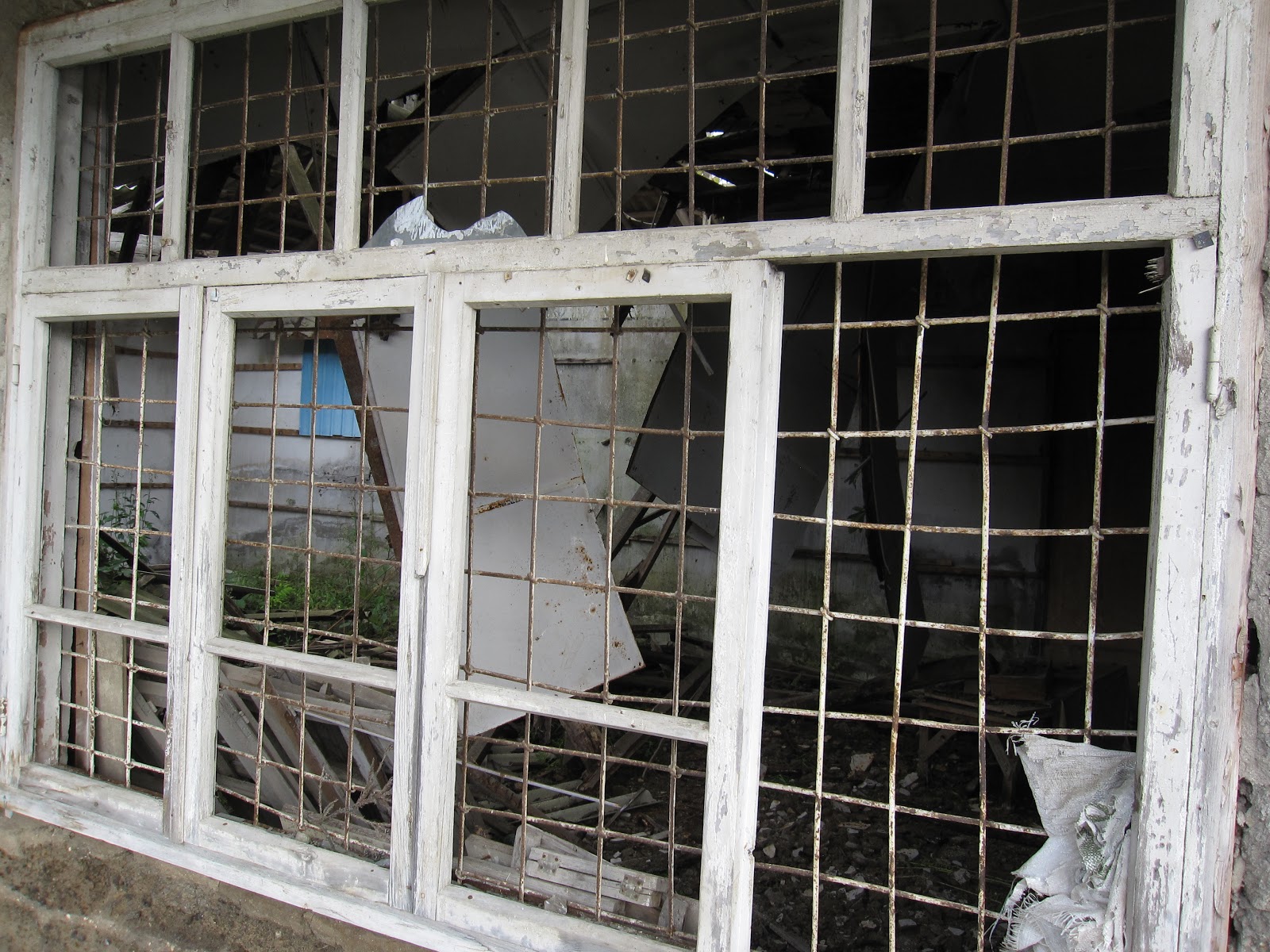
            In the villages I hear the same story time and time again: “there are no jobs, there is no money, and all we have is what we can provide for ourselves.” The despair of this situation even extends to a number of those who are employed but in jobs that pay a pittance for more work than should be expected of an individual, and, especially, to those on government pensions, which were described to me as being woefully insufficient to support anyone in their old age. One day walking through the village of Supsa, the first village I lived in here in Guria, with the coteacher of a volunteer at a nearby village’s school we passed by a series of dilapidated, abandoned buildings, inconsonant in there large size compared to the surrounding buildings. We were told that these buildings once housed two of the major industries of the region: one, a textile factory, and the other a tea plantation (Georgia’s Guria region once grew moat of the tea for the USSR), but now all that was left were skeletons of these once thriving industries. With the collapse of the Soviet Union and the subsequent period of resurrecting a nation out of its rubble these industries and industries across the nation crumbled, taking the jobs they provide and the incomes they distributed with them. These skeletons of industry dot much of this country; travelling around I see abandoned buildings everywhere, painful reminders of what once was and what is now the slow decay and a belabored memory of human sacrifice and effort.
            The economic and personal woes of the people are not only bound up with the loss of these industries, but are also exacerbated by the fact that in the remote areas of the country nothing has sprung up to replace the industries that many of these villages grew up around. What jobs are the people of a small, remote village in Georgia supposed to take on? Aside from the government jobs (police officers, teachers, etc.) and those providing necessary services (shopkeepers, manufacturers of building and home supplies, etc.), there seems to be little work in many of these places. The most common occupation seems to be for people to sell whatever they have gleaned from the land; the streets of Ureki are dotted with stalls of people—usually old women—selling fish, fruits, nuts, and whatever else may be in season at that point. Talking to my host mother, a teacher in the same school as me, I learned that, in fact, almost all of the men living on our street are without work, especially the young ones. They are all able-bodied men capable and willing of hard work and physical labor, but there is nowhere for them to apply their skills. The young men I speak to hold out the hope of soon leaving for Tbilisi, Batumi, or another urban center where work is more readily available, but for the older people, the ones who have lived here the longest and have invested the most in this place, there is no hope of leaving; they are stuck in the home that they built themselves or that their parents built before them, forced to scrape together the resources to maintain a reasonable level of material well-being.
            Though the situation I describe is disconcerting, I do not want to paint a picture of people living in abject poverty or squalor. Even those struggling the most are still able to find a reasonable sense of material security and to live comfortably, though there is always the threat of having the rug pulled out from under them. This threat is, however, assuaged by the fact that those surrounding them, their friends, neighbors, and the community as a whole understand the woes that plague so many across Georgia and are eager to lend a helping hand in their hour of greatest need. Their needs are met, but they lack any real sense of hope for a brighter future. Upon being pressed they will concede that things are slowly getting better, that more improvements both in terms of job creation and infrastructure improvement are being made every day, but for most of my older interlocutors this is not a real source of hope. Often they feel that while around the country improvements are being made, those improvements are a long time coming in the villages, and I can’t fault them for this bleak outlook.
            Having travelled around Georgia to a fair extent I have begun to see where the government is investing. All the major cities and tourist destinations are sites of industrious activity; major construction projects are being undertaken in Tbilisi, the whole downtown of Batumi has a newness about it, and the whole downtown of Mestia, a small town but the only major town in the mountainous Svaneti region—a major tourist destination—is being renovated: soon nearly every building on the main downtown street will have been built in the last few years. While it is important for Georgia’s economy to create centers of business and tourism, the government’s primary duty is to its citizens, who, out here, have the dejected feeling of being neglected. There are those who have found success in this new climate of the cities being major business and tourist destinations; they have been afforded opportunities that did not exist prior to the current president or during the Soviet Union, but these stories of success are, for me, balanced and outweighed by the stories of struggling villagers.
            What is most enigmatic to me is that in the same regions that seem to have been hit hardest by unemployment are the regions where the infrastructure is most lacking, where roads have fallen into disrepair, where once impressive government buildings stand abandoned or at least look like they should be abandoned, and where sewage and water systems are antiquated at best. The event that typifies this neglect of infrastructure in my mind came one day while walking around downtown Supsa. I had admired the train station there for a long time, marveling at how it seemed to be in worse shape than many of the wholly abandoned buildings I had seen around town. The awning over the platform is collapsed, there is nothing inside the main room other than the ticket booth and piles of trash in the corners, and the entrance to the bathroom outside is choked with weeds and gives off a smell that would seem to indicate it had not been cleaned in years (I never mustered the courage to go in). But the experience that most made me realize the absurdity of the fact that this building is still a functioning train station is when I looked to the entrance of it one day and just watched a goat casually walking through and out of the entrance to the station, not paying any heed to it, as if it were no longer the domain of humans but that it had succumbed to being a part of the natural landscape again.
Though I have no pretensions of being an expert or anyway knowledgeable about matters pertaining to economic development or the processes through which a struggling nation addresses social issues, there seems an obvious solution to significantly and simultaneously addressing problems of high unemployment and faltering infrastructure: put the jobless to work making the improvements needed in their villages, have them rebuild the institutions and infrastructure that would simultaneously improve their standard of living and make those places more attractive for other industries and permanent sources of jobs to move into. I’m sure that this outlook on this situation is a reductionistic take on a complex issue and things are not nearly so simple; if they were, I have no doubt that someone in the framework of Georgian bureaucracy would have thought of and implemented it. But what I know is that from the talks I have had with the people of the villages I have visited and in which I have lived there is a feeling that the Georgian government is not sufficiently providing for the people, and in its stead there is no functioning private sector to provide the jobs and material well-being that are lacking.

There once were jobs here

and here


and probably here too


            While this may all seem very critical of the Georgian government, I would like to say that some of the projects the government has undertaken are very positive and are, in fact, looking out for the interests of its citizens, although many people may not have thought of the full implications of these programs. One such program is the one I am a part of: Teach and Learn with Georgia. The importation of hundreds of English speakers from around the world into Georgia to teach English to school children is a forward looking initiative that serves to foster the level of proficiency in English among the Georgian, further enabling Georgians to find a place in world markets and the world economy, where English is an important means of communication, and helping tourism, as many of the visitors who come to Georgia are more likely to speak English than Georgian or Russian. The program also has the added benefit of bringing fresh ideas into the country. In many places, especially in the villages, the Georgian education system maintains a distinct post-Soviet feel, especially as most of the teachers were schooled and trained during the Soviet Union. But by bringing in teachers from around the world and pairing them with Georgian teachers there is an opportunity for those Georgian teachers to improve their language skills as well as to be exposed to new and alternative teaching methodologies. This program also coincides with a number of other reforms to the education system that will help foster a better future for many Georgians. For example, schools are being equipped with more and newer technology and students are being taught how to use these technologies, something of utmost importance as many students will eventually find themselves working in areas where knowledge of current technology is of an increasing importance.
However, these sorts of programs are not the full answer to the woes that Georgians have conveyed to me. These programs are great at looking at the long-term, and are especially well-suited for the large urban areas that are poised to become important centers of commerce and tourist destinations, but they do little to alleviate the hardships of the people in rural areas, where more immediate solutions are needed. I am glad for the programs, but concerned that they are leaving behind an important sector of the population, the population outside of Tbilisi, Batumi, and Kutaisi. The juxtaposition of these new programs (the Georgian Ministry of Education has also provided small notebook computers to first graders) against the state of the schools is at times striking. I have made the comparison before that in many ways like spending a lot of money to furnish and decorate a house with a crumbling foundation. I have seen a number of schools with physical structures falling apart, bathrooms I would consider unusable, and even in one case was shown by a student where I could grab onto a staircase’s handrail and feel a minor jolt of electricity. New computers and good English teachers are important parts of Georgia looking forward to the future, but so are addressing the basic infrastructure concerns of the school system and elsewhere.
This digression about the school takes me away from my impression of how people around Georgia think of the Soviet Union, but it is a related topic. Many of the older people remember the Soviet Union as a time when many of the countries institutions were better. Just last night I was discussing the prospect of receiving mail in Ureki with an older woman in the village, who described how well the postal system used to work but how unreliable it now is. During the time of the Soviet Union apparently one could reliably expect to receive packages or letters from anywhere in the world, but now it is often questionable. I suppose for all its faults, the Soviets did do a good job of creating and maintaining public institutions like the Postal Service and public transportation. This is not the first time that I have heard people around the village muse on what was better in the Soviet Union. Many remember the Soviet Union providing many services that now are beyond their ability to afford. Before, any operation or medical procedure one needed was paid for by the government and could be obtained relatively quickly, but now the price tag is too steep on many of the same non-essential medical procedures that were once covered. This fond remembrance of the Soviet Union is not limited to the institutions people sees as having been better suited for serving the country’s citizens. One person I spoke with also, perhaps paradoxically, remembers the time of the Soviet Union as being a time of greater freedom, especially freedom to travel. The Soviet Union was never viewed by many in the west as giving its citizens the utmost freedom, and it was undoubtedly difficult for citizens of any of the Soviet Republics to travel outside of the Soviet Union, but the whole Soviet Union was open to every citizen—an area that is more than twice the size of the United States—and travel across the Union was cheap.
These paradoxical statements lamenting the loss of freedom that existed under the Soviet Union are not isolated to one or two conversations. I remember a long and revealing conversation I had with a Georgian man at dinner one day in which he held forth for an hour about how things are now and how they used to be. A major part of his lament of what was lost in the collapse of the Soviet Union stemmed from the loss of freedom of travel. He conceded that it is true that under the Georgian government a Georgian citizen can travel almost anywhere in the world without a problem, but he countered this by pointing to the reality that most Georgians are restrained now not by the government but by economic realities. Relatively few Georgians can afford to make trips to the United States, Western Europe, or many other destinations around the world, making the areas no more open than when the citizens were wholly forbidden from visiting those countries. While those areas of the world may in reality be just as unattainable as they once were, the current economic and political situations have also closed off much of the former Soviet Union. Whereas it was once extremely cheap to travel from Georgia through Russia to Ukraine, Estonia, or any of the other Soviet Republics, it is now either extremely difficult (in the case of Russia) or very expensive (everywhere else, with, perhaps, the exception of Armenia). Many older Georgians I have spoken with spent time in Russia, Ukraine or one of the other Republics, and even more have family members of other nationalities, a product of a time when one could easily move around the almost unfathomably large, and surprisingly diverse, Soviet Union.
And it is not just freedom of travel that many of the villagers miss about the Soviet Union. While in many ways the isolationism and xenophobia exhibited by the USSR was a negative for its citizens and for Soviet relations with the rest of the world, there was an upside to it, as has been described to me by a number of Georgians. As part of its isolation from much of the world the Soviet Union strove to produce much of what its population needed in the Republics. Thus, the tea factory and the textile plant that are now standing skeletons and bleak monuments in Supsa were a necessary part of the economy. The people of the village were needed to work, not just for their own well-being, but to help provide for an empire stretching halfway around the world, and so jobs were plentiful. My interlocutor continued to describe the atmosphere of that time, claiming that unemployment was as low as 2% (he may be exaggerating and the number as it was given by the Soviet bureaucracy was undoubtedly altered), but at present—again, his claim—unemployment is as high as 18%. He did not say how the quality of life compared then and now, but I get the impression that in his mind it is better to have a population at work than to have a slightly higher standard of living, as a population at work is a population that is actively engaged in producing for itself what it needs and is unable to fall into the sort of idleness that he perceives as plaguing the unemployed village populations. As he explained to me, what has filled the void of lost jobs in Georgia is either, on the one hand, people idling away there time, filling their days with drinking and carousing because there is little else to do, and on the other hand, being driven to find work abroad. For many living in Guria, a short distance from the border with Turkey, the lack of jobs in Georgia has driven them south across the border into that country to work. He described to me the plight of so many, going to work for weeks or months at a time in Turkey to support a family at home, when once upon a time the same work could have been had in Georgia. And though this is one of the points I believe the man to have been most biased, he gave an account of the lives of those working in Turkey as being ones of perpetual hardship. I believe his exact words, given in Russian, were “we go down there and work and work like horses, and get nothing for it” and later “You go down there to work and they tell you: ‘Oh, you are a Christian. That will be a problem.’” This last statement was accompanied by an exasperated exclamation that in Georgia they realize that if someone is a Christian, Jew, Muslim, Hindu, etc. it does not matter, we are all people, and that those Georgians working down in Turkey to provide for their families just wish they could find the same attitude.
Again, I want to mention that this information is from a somewhat biased source. I do not want to slander the people of Turkey, and have little verification of what the man said. But at the same time, I cannot fault the man for his biases. He is in a situation of economic hardship, and such situations easily skew the way we view and interpret reality. I do not intend or want to make a statement judging either the Georgian government for any failure to produce jobs, as I have not the scope or knowledge to evaluate their work, or the people of Turkey for their treatment of Georgian workers, which I have no real evidence for. Rather, I find it fascinating that the climate I am surrounded by in this country is one where many of the older people of the villages I have lived and visited look back on the Soviet Union fondly and miss many of the features of that life that have now changed. It’s difficult to say how earnest they are in this and how many of them would gladly trade what they have now for what they had then, as it seems in many cases that the people I have spoken with have succumbed to the sort of idolization of the past and glorification of the way things were that is easy for us all to fall into. It is easy to look back on the past and focus in on the great things that may no longer be and forget the difficulties and minutiae that either make that time indistinguishable from the present or make the present preferable to the past.
I suppose my intention in writing this is to present a common attitude that many of our Western eyes would see as ironic, insofar as I’m sure most who know anything about the Soviet Union think of it as a particularly positive thing to look back on. I also want to emphasize that viewpoints on the Soviet Union are also varied, vacillating between the idealization I described and vehement disdain for that time and for the Russians who are viewed as heartless conquerors. It is unfortunate that most of the people with whom I have spoken are part of one older generation who grew up and lived in the Soviet Union; I would love to speak with a younger generation of Georgians about how they look on the Soviet period of Georgian history, but I am faced with the reality of being unable to communicate with most young Georgians, especially out here in the villages, where English proficiency is lacking and where most young people don’t bother to learn Russian. Lacking a full dataset, I would encourage nobody to draw any conclusions about actualities of life in the Soviet Union and the attitude of the Georgian people as a whole from what I have written, but I think my experiences attest to a reality that in the growth and development of a nation there are times and events that can be viewed and interpreted in radically different ways.

Tuesday, October 11, 2011

Ch’a-Ch’a and Mountaintops

     In my first three weeks living in the village of Supsa I did not leave except on a few day trips to Poti and the beach at Grigoleti, neither of which are further than 15km away. I had not seen or conversed with a native English speaker in person in those three weeks and drastically needed something new and different. For the following weekend I weighed my options of what I could do to fulfill this need, and I considered a couple options: I could go to Tbilisi, meet up with a few friends, talk in English a lot, spend money on transportation, food, and a hostel; or I could take off and go somewhere on my own to venture into the Georgian wilderness that was one of the great draws in my coming to this country. I opted for the latter. I settled on setting off for Borjomi that Friday with the intention of spending three days backbacking through the Borjomi-Kharagauli National Park, one of the most beautiful and most well-preserved forests in the Southern Caucasus. Not knowing exactly where I was going (relative to other places in Georgia) or exactly how to get there, the father of my host family arranged to have me picked up by bus at the Supsa Police Station, at which point I was told I would have to take another bus to Borjomi and that the driver would tell me where to get off. My host father told me that I had to leave at 10:00, the same time I was supposed to teach. When I pointed this out to him, he just explained that it was no problem. He would tell my students what was going on. People here know their priorities. After a bus ride of admiring the changing Georgian scenery from the subtropical coastal plain in which Supsa is located, to the mountain range that marks the boundary between Eastern and Western Georgia, and to the dry plains of the east, I found myself standing in front of a gas station in a town whose name I can never remember, feeling sufficiently lost and confused. The bus driver told me that maybe someone at the gas station could tell me how to make it the last 30km to Borjomi. Other than that, I was on my own to find the way.

After watching the road for a while, hoping to find a passing Marshutka (the mini-busses that are the most ubiquitous form of public transport in Georgia and, I suspect, most of the former Soviet Union) to take me to Borjom and seeing none, I mustered the courage to ask one of the gas station attendants where I could find a ride. Upon asking a group of men sitting outside the station, I was told that one of them was willing to drive me to Borjomi. Thinking this was just another fortuitous manifestation of Georgian kindness and hospitality I began to take him up on his offer when he informed me that he was willing to drive me for a mere 25 Lari, a real bargain at almost a lari a km (about a dollar every two miles). I’m sure that to them with my long hair and large backpack I seemed like the sort of ignorant tourist who would take them up on their so generous offer, but I had enough sense about me to know that they were trying to rip me off. And so I bargained with them, setting a line at 5 Lari that I would not back down from. They refused to meet my price, and I was all set to walk the thirty kilometres to Borjomi if I had to when one of the older men present, the only of the group who spoke good Russian, had pity on me, took me by the arm, led me to the edge of the parking lot and directed me 100 meters down the road where I could find a bus/marshutka stop. The whole experience at the gas station left a bitter taste in my mouth, as I saw a side to Georgia that I had not seen in Supsa. Whereas most people here are willing to treat guests with great kindness, respect, and hospitality, I met someone that day who was so eager and willing to take advantage of someone he thought to be ignorant and vulnerable from an inability to communicate. It acted as a sober reminder that even here, in a culture so different from my own, people are still people, and there are still those willing to help themselves by taking advantage of others. So often we who are here–I suspect it also happens to those travelling in other foreign countries–tend to idealize and romanticize the new culture and the new experiences, unwilling to really confront the negative aspects or to be critical of things that deserve being critical of.

But that encounter did not mar the trip that was to come. I soon found a Marshutka to Borjomi for 2 lari, much more reasonable than the 25 I had been offered 15 minutes before, and soon I was in the city of Borjomi at the offices of the National Park. There I soon found where I had to go to register to enter the park and receive a map, and was amazed by the service I received. I am used to hiking in America, where the most I have ever done to register to hike is stuff a little piece of paper I filled out in a box, but here, in Georgia, the Borjomi Park has a well-developed system of registry that is comprehensive, efficient, and personal. I walked in to an office, was greeted in English by a park representative who not only knew basic English, but converse with me and answer all my questions fluidly and comprehensively. It was the best English I had heard in person in about a month, and was very refreshing. I loved not having to stumble my way through the interaction tripping over case endings and butchering verb tenses, but being able to express myself fluently in my native tongue. After our greeting, the man sat me down, pulled out a park map, and for the next thirty minutes detailed all of the options open to me for the next 2 ½ days. He showed me all of the trails, explained their layout, the difficult parts, and the ambiguously marked places to me in such a way that made me confident I would not get lost. He was skeptical of my ability to hike the 15km to the first shelter that night (I would not get on the trail till at least 4:30), and thought that making it 10km the last day to catch what he claimed to be the only train out of the village of Marelisi was a little risky, but I did all I could to reassure him that I knew what I was doing. I paid the 10 lari for two nights of camping and set out for the village of Likani and the start of the trail. Likani is only 5km from the Park offices, and though the park officer recommended paying the 4 lari for a taxi, I went through one of my bouts of not wanting to pay for anything I didn’t deem to be absolutely necessary and resolved that I would walk the 5km or, if the opportunity arose, hitchhike the whole way.

After walking along the roadside and refusing the reasonable offers of a few taxi drivers to take me to the park entrance, I eventually waved down a passing large truck hauling some kind of farm equipment, and much to my surprise was being spoken to in English by the driver. I thought I explained to him that I wanted to go to the park entrance in Likani, and he assured me he knew where to take me, and so we set out, conversing in somewhat broken English. It was on this truck ride that I had one of my more interesting, and more negative experiences of the trip. The driver explained to me that he had lived in Philadelphia for a number of years and had driven 18-wheelers across the United States. It was fascinating listening to his comparisons of life in Georgia and life in America, his frustrations with Georgia and its government, and his frustrations with the American government over the immigration process. His English was very obviously gleaned in America, and was peppered with more cursing than I had heard in casual conversation in a long while. I don’t remember all of the details of our conversation, as most of them were overshadowed by one question. At one point the man turned to me and asked “Do you like niggers?” I was so taken aback by this question that for a few minutes I did not know how to respond. I just sat there dumbly for a few seconds trying to figure out how one tackles the issue of race relationships while hitchhiking with a truck driver far away from where he lives in a foreign country. I decided that there were a lot of larger issues I wanted to avoid and opted to just explain to him that I had some very good friends who are black. He responded less harshly than I expected and conceded that there were undoubtedly some good black people, but that in general he saw them as not willing to work and just living off handouts from the US government.

It was only later that I was able to process the implications of this exchange. I do not think that his dislike of black people comes from any sort of true racism, but that for him, the race serves as a scapegoat for the frustrations he still feels about his time in America. He was a poor immigrant who made his way to America through legal channels, finding a good job and a life better than the one he had in Georgia. But as an immigrant he had to fight to stay in America every step of the way, battling to keep his green card and his legal status. He fought and fought to be in America, being given nothing by the government but battling against them, while he saw a group of people without jobs living on the welfare of the US government. This group was certainly composed of people of all races, but in his mind it seems he began to associate it with one in particular. Undoubtedly he met among that group many who were not earnestly doing anything to make their own way through life but who were very comfortable in their status of being cared for by the government. He was embittered by the fact that people without work, living what he saw as an easy life were being given everything while he, a hardworking man with a difficult but good paying job faced the risk of having everything taken away at any moment. It was from this position of anger and contempt that he asked me his question. It seems he created this reality in his mind where it was the black population who were the ones not willing to work and reaping the rewards of the money immigrants like himself were giving back to the US government that would soon kick him out of the country. Through a series of logical connections, somewhat tenuous from an outsider’s point of view, it was the black population who was responsible for his return to Georgia and his return to driving a truck on poorly maintained roads, dodging cattle at every turn, and needing to vent his frustrations to unsuspecting American hitchhikers. His blindness and willingness to draw this caricature of a whole race was still appalling and inexcusable, but I began to understand where it came from. I in no way found him justified in his generalizations, but found him pitiable within them. His was an unfortunate situation, but not unfortunate enough to warrant bigotry. That one question left me with a sour taste for the whole ride, and cast a shadow over the Georgian people in my mind that, fortunately, was soon overcome by the overwhelming kindness of a few others.

I did not have time to discuss all of this with him, as soon I realized he had taken me 10km past Likani (I was, and still am, a very bad judge of distance in kilometers), and I immediately had him drop me off in front of a store in some little village a long ways from my trail. As I got out of the truck and realized how far I was from the trail I became extremely anxious, as daylight was slowly fading and I had a lot of walking left to do. But my anxieties were soon assuaged, as within three cars someone going the opposite direction had pulled over to take me to Likani. We made it to the village, I found the sign to the trailhead, stopped in a little store to buy some bread (for some reason I thought two loaves of bread and some granola bars would be enough food for three days), and I set out on my hike. One bad hitchhiking experience was redeemed by the next, as my second driver not only took me to my destination, but upon seeing me looking at my map of the area around the park pulled his car over and began pointing out all the places I should go in the area. I started my hike with a renewed confidence in the Georgian people.

As I walked up the street to the park entrance, the village of Likani soon yielded to the wilderness of the park, and I found myself in a forest unlike any other I have been in. Once I overcame my anxieties about the late hour of my start and my constant worrying about whether I had missed a turn-off for my trail, I found myself put at ease by the forest. Surrounding me were hemlocks, pines, elms, and a species that looked a lot like ironwood (I can never remember the genus), with a rich understory of mosses, sedges, and shrubs, among them many in the rose family, though without flowers or fruits I could not be certain what they were. It was one of the most mesic forests I had ever hiked through, especially on the north side of the cove that the first 8km of my hike had me scale through a series of switchbacks. It was on this uphill hike, feeling my legs once again burning underneath me, looking out at the cove spreading out below and the opposite ridge looming high reminding me I still had a long way to go to the top that I realized just how much I needed the mountains, how my spirit felt stifled by life on the coast with everything so flat around me. I come alive in the mountains. Many of my greatest memories of childhood through my time in college are associated with mountains, with wilderness, and with seeing the forest below me, both welcoming me to enter and warning me against pride in my humanity, as all of the forests I have loved were there long before me and will be there long after I am gone. I was alone and I was free. Georgian culture and American culture no longer mattered; it was only the wilderness and I. Like a kid in a toy store shown a set of games and toys he had only dreamed of, I was free to explore this forest in which nothing was entirely familiar. Everything was steeper and more rugged than my beloved Appalachians, seeming like a glimpse into what those mountains may have once been, and the flora, though at times eerily familiar, was simultaneously entirely new. I could rattle off genera and families, but was lost as to the species. The trees and flowers invited me in, challenging me to notice the subtle differences between themselves and the plants I have learned. On that afternoon my botanical curiosity was only curbed by the fact that each minute not spent hiking was another minute I would have to spend finding my way in the dark. But regardless of the encroaching night I could not help myself and had to stop for each new flower I passed, puzzling over what it was and what made it grow where it did. My amazement with the forest only heightened as my climb that took me up 1000m in the first 10 km led me to a ridge line on which the mesic cove forest yielded to subalpine meadows and a spruce-fir forest that drew my memories back to a period two months earlier when I was making my way through similar habitats along the Blue Ridge Parkway while doing work for the US Forest Service. While the forest type itself drew me back to North Carolina, the views from the meadows did not have the same effect. The sheer breadth of the forest, expanding in every direction punctuated only by the occasional small village far off in the distance and the ruggedness of the mountains reminded me that these were not the mountains of the home I grew up in, but were the mountains of my new home, the mountains I want to explore and come to know, the mountains of stories by Lermontov, Tolstoy, and Pushkin that captured their imaginations as they were mine.

It was walking along this ridge line through these meadows with breathtaking vistas spread out before me on either side that I began to think about beauty and what it means for a place or a people to be beautiful. It was here that I realized that beauty is not something tied to the senses, but is extrasensory; it is a message communicated from one object to another on a level that cannot be quantified in sights, smells, and sounds, but is a message spoken from one spirit to another. As has often been the case in Georgia I was first struck by the physical beauty of the place: the beautiful views, the flowers and the play of the crepuscular glow through the dark green of the pristine spruce-fir forest. It is not only in the mountains that I have become aware of the physical beauty of this country. The black sand beaches of the Black Sea and their rocky counterparts to the south, the mountains in Ajara rising straight out of the sea, and the lush green of the subtropical west all produce a similar effect. When I take time to stand and look around me I am taken aback by how novel, unique, and beautiful it all is. And I feel the same way about the Georgian people. Whether it is the product of being in a new place surrounded by a people with whom I had had little contact previously or that it really is that Georgians are an especially atractive race, I am perpetually struck by their beauty.

But what I have seen on the surface level of the physical cannot encompass the beauty I have found in this place. In the mountains I was not an observer or consumer of beauty, detached from it and taking it all in, but I was a part of it. I could feel the pulse of the place. With every step I could sense what lay beneath the physical surface of the forest; the beauty I found was not caused by the array of colors or the physical impressions, but was bound up with the internal experience of the place. The beauty was contained in what was communicated between the mountains and the forest and myself. What I experienced left me with an overwhelming sense of peace and fulfillment. In the forest I felt myself being restored, reinvigorated and fulfilled. That park spoke to me in a way that cannot be qualified in the language of the senses but is contained in the affect, the communication from one to another. This beauty is not contained in the thing itself nor in the perceiver, but in the communication, in the act of the affect, and in what is born only of a relationship.

As I found the beauty of the park to be something existing beneath the surface of what is sensed, so I have found the same to be so with the Georgian people. I have met many girls around my own age here of incredible physical beauty, but I have increasingly become aware of a more penetrating beauty contained in the older generation, those people who struggled and labored for decades through the hardships of the Soviet Union and through the age of a nation being born out of the rubble of its collapse. I see grandmothers working twelve hour days in the markets in town just to have a few extra lari at the end of the day to feed their families; I see women living and working at home, doing more to keep the household running and the family together than any will ever recognize them for; and I have seen men forsaking the cultural norms and acquiescing to the position of living off their wife’s meager teacher’s salary but who at every turn are willing to do the work to keep a household running traditionally relegated to the women. In them there is a subtle but powerful beauty that comes through perseverance, devotion, and the fulfillment of what they believe their duty towards their family to be. I don’t mean to glorify the gap that exists between men and women in the country; it is unfortunate that the social structure exists in such that gender roles are rigidly defined. But I have found such strength of spirit in which women approach the life they lead within those social structures and in the men who recognize the need to forsake those same norms.

I think my experience with beauty in the Borjomi-Kharagauli Park is best represented by a gentian I came across my first evening and that I saw everywhere in the high elevation meadows the next day. Gentians have for a number of years been one of my favorite flowers. There is a group of them that have strikingly beautiful but delicate flowers that never truly open up, and these I have found especially captivating. They remain in a closed state, forcing pollinators to crawl in rather than just landing in passing. They do not attract these pollinators with a promise of ease and convenience, but with the mystery of what riches may lie inside. There is something very coy about the whole process. They do not need to bear everything to attract a pollinator, for they are confident enough in their own ability to attract that they can remain almost entirely closed without worrying about failing to procreate. I have a great memory of being in Sewanee, hiking around Lake Dimmick, seeing such a gentian while on a class hike and after looking at it for a few minutes seeing a bee crawl out of the top, covered in the pollen it was given to deliver to the next gentian it comes across. It was a moment of unexpected beauty in which I stood amazed by the flowers ability to hide from the world the amazing process going inside through which it is able to live on from generation to generation.

The gentians I came across here in the Caucasus were some of the most striking flowers I have seen, more vibrant and colorful that any other gentians I have come across. Their flowers have petals that alternate between a vibrant violet and a deep, rich purple that borders on black. In the dying light of the day as I hiked along the ridge line these colors stood out in sharp contrast to one another, with the violet holding on to and reflecting all the light of the day while the darker had already embraced the coming night. The pictures I have hardly do justice to the impression it invoked, as even my own immediate sensory perceptions in that moment do not do justice to what I found in these flowers. While that evening I greatly appreciated the flower for its pure aesthetic value, the botanist in me appreciated it on a very different level. What is beautiful about it was not the colors, but is what lay beneath those petals and what led to the very existence of each of those flowers.

Each one of those flowers is the product of hundreds of millions of years of plant evolution through in never-ceasing process of natural selection. The flower is perfectly designed for the niche it fills, but was not designed in one go; its design was crafted through the millennia by the slow drift of natural selection. Every configuration of leaves, petals, colors, pistils, and stamens was selected over countless other possibilities. Perhaps some of it occurred at random, but I have for a long time and still do struggle with the notion that natural selection allows for “random” configurations. Each of those gentians is filled with a myriad of purposes; every individual feature of the flower served or serves some end. Each distinct feature of the flower is for something. The colors of petals are for the attraction of pollinators, and somewhere along the species evolutionary history those colors that stood out so vibrant to me were selected because they in some way helped the plant better succeed in attracting the insects that do the work of ensuring the continuation of the lineage. The shape of the flower, perpetually closed rather than fully opening, is also “for” something. I do not presume to be able to explain what it may have originally been for, but I wholly believe that it could not be without purpose. It was chosen over every other DNA configuration and the mutations that over generations challenged and molded its shape, offering countless variations to be tested in nature’s laboratory for their ability to contribute to a species’ survival.

This scientific experience does not cheapen the aesthetic experience for me, but heightens it. The fact that we find such beauty in the natural world in things that are for a purpose that has no connection to why we find it beautiful amazes me. The shape of the gentian probably came about as a more effective way to ensure any pollinator would take with it as much pollen as possible, but to us it belies something secretive, something mysterious. For me the true beauty of the flower not only lies into the shape and array of colors but what it took for all of those features to get there. While most of us are not thinking about all of the floral parts or the evolutionary advantage of the sweet smell of a flower, perhaps the millions of years it took to form that distinct flower plays into what is communicated to us in our appreciation of its beauty, lying beneath the surface of what we are consciously aware. We so often stand in awe and respect when we are confronted with great age: the redwoods of California, the pyramids of Egypt, and many of the great cities of Europe are all made more beautiful when you take into account their age, the multitude of years it took to make them what they are and the years that they have endured and persisted. Perhaps some of that same feeling underlies what we sense in something as simple as a flower. In that flower are millions of years of being crafted, molded, and structured. It has inevitably survived ice ages, severe droughts, and other extremes, but persists on in its beauty and delicacy.

But many of these thoughts about the gentian only came about later, for though enraptured in the moment by its beauty I still had a number of kilometers to go before the spot where I was to camp. I pressed on, following the ridgeline upward and upward, witnessing on the way one of the most spectacular sunsets I have seen that set the far distant mountains on fire, coloring the sky with brilliant shades of orange. Following this spectacular sight, I hiked the final quarter of my evening’s walk in the dark until finally arriving at the shelter where I would stay for the night. As I reached the shelter I found that I would not be alone at the site that night, and as I went to find a campsite was greeted with a “hello” from a couple who were sitting at the picnic shelter outside the shelter. I noticed the man’s voice was accented, and I was intrigued to know where he was from, but first I wanted to find a campsite. As I found a suitable spot free from the trash and horse droppings that were unfortunately present in abundance at the shelter (the rest of the forest, however, was very pristine). The man came over to where I was setting up and invited me to come over to the shelter to share tea and brandy with him and his wife. With a hard day of hiking on legs that had not been on a mountain in over a month and that had not backpacked in much longer, and only half a loaf of white bread to look forward to for dinner, I was eager to jump on any opportunity for something hot to drink. And at this point I had not had a real conversation in person in English in a month and was ready to not stumble over every sentence in mediocre Russian or atrocious Georgian.

The couple ended up being Polish tourists travelling around and camping all over Georgia. The man spoke great English, and we conversed about cultural differences between Poland, America, and Georgia, all the while passing around a single cup that we filled with the tea and brandy a number of times before we decided we had had enough. I thanked them repeatedly for inviting me in to share the elixir with them, as my hopes for the wonders of a hot drink at that moment in time were completely satisfied; it was the perfect end to a long an interesting day. As we said our goodnights I lingered in the shelter, thinking about the trip thus far and what lay ahead of me. What had earlier been anxiety about almost everything—finding transportation, not having enough food for the trip, and the fear of losing the trail—yielded to a penetrating warmth of the tea and brandy as well as the sense that in this country everything has a way of working out. Every situation that could have turned out horribly that day worked out in some of the best ways possible. I had taken me first big solo outing out of the village, I had hitchhiked for the first time in a foreign country (and maybe for the first time ever), I found myself in a pristine forest in the heart of the rugged South Caucasus mountains, and my meager supper was turned into a fortuitous meeting of an interesting couple who shared with me the hot drink that I had been yearning for on the walk. I know that whatever the rest of the trip would throw my way things would manage to turn out just fine.

After surviving the torrential downpour that began to soak everything I had with me and that drove me from my makeshift tarp-tent into the shelter in the middle of the night, I set out early the next morning to make it to the top of Lomismta (2200m above sea level) and in all 18 km to the next shelter. I said goodbye to my Polish friends who were heading back out of the park later that day expecting never to see them again and began the day with a nice uphill climb to remind me legs of what they had done the day before and how they could use to be in better shape. Soon the coolness of the spruce-fir forest gave way to a section of fields with the sun beating down upon it, which combined with my heavy pack and physical exertion to make things very warm, driving me to decide to hike shirtless. I mention this not to invoke in you a nice mental picture of me braving the Caucasus wilderness shirtless, but because this detail is important to what soon followed that constituted one of the most unforgettable experiences I have had in Georgia.

In the fields the trail became hard to follow, as it split into a myriad of livestock paths that seemed to have been formed and molded over decades if not centuries and I once again became anxious about losing the trail, especially when the path seemed to lead to a small shack and horse paddock in the middle of the field. But the trail continued and as I crested the next hill I saw a small building and a few people beside it on the top of a ridge in the distance that overlooked continuous forest on three sides. After consulting my map I figured out that this must be one of the old churches present in the areas of the park that are also regularly used by herders and farmers. There was nothing I could think of about an Orthodox Church in the middle of a pasture overlooking steep forested valleys of the Southern Caucasus wilderness that did not appeal to me, and so I set out along the livestock paths that seemed most oriented in the direction of the church.

After reaching the ridge along which the church is located I soon ran into one of the people I had seen from afar. He completely typified the image that comes to mind when I think of a man from the Caucasus; he was stoutly built with a large hooked Georgian nose, had on a ragged turtleneck and the stubble of a number of days in the mountains on his face. He was leading a white horse along an old cattle trail and at the moment of our meeting was sitting on the ridge above me, glaring at me with a piercing gaze that made me feel that I was far from welcome on that ridge. His eyes that stared me down belied a depth to his life, a hard life of eking out a living on the mountaintops. In a gruff tone he confronted me about where I was going and what I was doing. He insisted he knew Russian, but in fact spoke very little; and so I was left mostly guessing at what he wanted from me in Georgian, unsure of whether I could walk to the church a couple hundred yards away. After an exchange that consisted more of charades than words I realized that what the man wanted from me was for me to put my shirt on before even going close to the church. So I did. He then told me to go to the church, and proceeded to follow close behind the whole way. At this point I felt more unwelcome than I have at any other time in Georgia. I sensed hostility in the man’s voice and a reluctance to let a foreigner enter into a land he considered to be his own; but having made my intentions known, I was not going to let his hostility force me to back down from my journey to the church and its view of the valley below that I had set my sights on. My dismay at his treatment of me only lasted a short time as when I finally made it to the church there was nothing else I could think about other than the vista set before me. From the front of the church extended out on three sides valleys of lush green. I was looking out over the park in all the glory of its pristine forests and the dark, mesic valleys that had captivated me on my walk the day before. In the distance I could make out a series of sparsely distributed villages: the only signs of human presence before me. Those sorts of views were what drove me to the mountains in the first place that weekend, and finding myself high above the rest of the world I felt alive, refreshed, and at peace with myself and my surroundings. This sense of peace was only heightened by the church behind me, for the experience of that place, with the church juxtaposed against the picturesque forest below stands out to me as one of those moments when the connection between faith and the natural world becomes glaringly apparent. That church was built on that mountain for a reason, and it was not for its convenience. That church was placed there for the beauty of the mountains. As the beauty of that land serves as a testament of the artistry of the hand that created it, so that church was built to thank that hand, to give back to Him who first gave that place its beauty. The church and the land consubstantially exist in a unified spirit of praise and thanksgiving for the beauty of the forest and the one who created it in all its glory.

As I went to enter the church I found myself followed by four men, the one who bade me enter to begin with, two young men around my own age, and another older Georgian whose appearance also denoted a hard life in the mountains, although his visage was altogether friendlier than that of the man I first met. None of these men said much to me, they just quietly shuffled into the church.

The interior of the church was not like that of the magnificent cathedrals of this country: there were no massive arches or domes, no gilded iconostasis, and few signs of regular use. There were a few icons hanging, one of the Theotokos in a gilded case before the bare marble altar, and a pile of icons to be bought or hung at a later time sitting gathering dust in a corner. The walls were stark white, the altar bare marble, and on the altar sat a stack of small beeswax candles and a few lari offered by passing travellers or the church’s regulars in exchange for a candle to accompany a prayer before the image of the Virgin and her child. It was simple in design, but powerful in spirit. It was clear that the church was the product of people who honestly and truly believed. They did not question whether it was worth it to build a church somewhere so remote, to put money into a sanctuary that would be used so sparingly. And it seems that at least that day their work was not in vain. The peace given me by my hike, the view of the forest, and the experience of being more than a mile high in the Caucasus left me in a state of spirit that prepared me and beckoned me to take time in that church, to offer up a few solemn prayers and to let the simultaneous feelings of joy, solemnity, and quietude wash over me and fill me.

This sense of reverence was heightened as I turned to the men coming in behind me. Up until this point they had said little to me other than scolding me for trying to walk to the church shirtless, and so I did not know whether they had any intention of being friendly or if they were keeping a close eye on me out of mistrust. But in that moment in the church I saw the second older Georgian man walk to the icon in front of the altar, bow, kiss it, cross himself, then proceed to pick up three candles. He took one of them, handed it to me without saying a word, and proceeded to light his own candle, offering up a prayer from the heart to be embodied in its flame. In that moment any wall of mistrust I perceived in the others was broken down and that spirit of Georgian hospitality, a spirit that trusts unquestioningly, shone forth. I took my candle, lit it before an icon of St. George and said some words of thanksgiving for all that had brought me to that point—all the people who had influenced me and all the events that had led to me being in Georgia doing the work I am here to do, and specifically for those that brought me to that church.

I left the church after the Georgians and as I did they greeted me and began to ask me questions—the usual ones about who I was, what I was doing in Georgia, and whatever else immediately came to their mind. It became quickly apparent that none of them spoke much Russian and that I was to understand little of their Georgian, but despite these difficulties I was still able to understand that they were inviting me back to their “apartment” to drink ch’a-ch’a and have something to eat. Not wanting to pass up an opportunity to have a meal more impressive than the half loaf of bread that I had rationed myself for lunch and excited at the prospect of trying more communication with the Georgians I immediately accepted the invitation. We set off, the two older men leading their horses along and the younger ones walking alongside me, and soon reached their “apartment,” the shack I had passed earlier. We sat down around a picnic table and the meal began.

They brought out the usual fare of a Georgian meal: tomatoes, cucumbers, parsley, khachapuri, cheese, and sausage; it was hearty food—exactly what I wanted and needed at that point. And then came the ch’a-ch’a. They mixed two bottles of liquid together, one completely clear (I’m assuming the stronger of the two) and one with a little color and some grape seeds floating in it. I to this day do not know what or why they were mixing, whether they were cutting the strong stuff or just consolidating resources, but I was not in a place to answer questions. Next they brought out our shot glasses: the necks of plastic bottles cut off with the lids still attached, which made for perfect-sized vessels. The meal began with the men forcing all the food I could want on me, handing me pieces of khachapuri and platefuls of vegetables as fast as I could eat them. Things started off awkwardly, as we had yet to figure out how to speak with one another and come to much understanding, but I was content to eat and admire the view from the shack. But then the toasts began. We went through the gamut of typical Georgian toasts, toasting to our families, our home countries, and me as a guest, but there was one toast that really touched me. It was one offered to the brother of one of the older men who had died the year before. This toast was especially touching when I found out who each of the men were. The older man offering the toast is a park ranger who was riding along patrolling the park, and who before that day he had not met the other man, a cattle herder on the mountain, and his two sons. It was the Park Ranger offering the toasts, and he toasted to the other man’s deceased brother to whom we drank. It was a moment in which the men’s rough exterior gave way to something so universally human: sympathy over the pain of a loved one lost. The rough exterior that they both put on could not hide the tenderness of camaraderie that began to emerge among the five of us dining and drinking together.

It was around this point, a few toasts of ch’a-ch’a in that communication became easier. We had no language in common that we could speak with any proficiency, but that ceased to be so important. Through our of experience of eating and drinking together, we began to understand each other better, to see past the layers of language and culture that separated us and to see each other as people, celebrating the act of eating, of nourishing ourselves for a day’s labor. It was at this point that I thought the ch’a-ch’a was to run out, a fact that had me very relieved, but I should have known better. We had exhausted the store of the cattle-herder, but, naturally, the park ranger had brought his own bottle to share with us. Luckily for me the five of us would not be alone to finish the bottle. Soon on the same path I had first come to the shack I saw my Polish friends from the night before heading along the field on the way to the mountaintop. Through a series of words in Russian and Georgian and a few gestures I realized that my new Georgian friends wanted the couple to join us, and so I led them to our table. More shots went around and more food was forced on each of us guests, and all the while I got to serve as a translator, somehow conveying the meaning (or at least the spirit) of each toast to the Polish couple. It was at that time I realized just how little of communication is actually accomplished through words and how much communication depends on the shared experience of the interlocutors. It was only after spending time with the four men, eating and drinking alongside them, that I began to be able to successfully communicate with them.

The change in the Georgians from the time I met them to the end of our meal was amazing. They had opened up, become extremely amiable, and as it was time to say our goodbyes they bid me to stay longer and the park ranger was giving me a thumbs up, pointing at me and saying k’ai k’atsi, which only later did I discover means “good man.” I departed from them with a warmth permeating my body from the joy of such a wonderful and unexpected feast atop Lomismta as well as the strong ch’a-ch’a that was still percolating through my body. I stumbled off through the fields where their cattle grazed along a ridge line overlooking two sides of the forest, amazed by everything around me, struck with the same sense I had the day before that in this country, things have a way of working out and that what I had experienced was not a chance encounter, but something inevitable, an event without other possibility. That day could have had no other beginning than that I would meet those men at that church and that we would have that feast together. From that point forward, nothing else that would happen that day, even the things that normally would make me extremely anxious, would be able to shake my inner peace. I was alone again in the wilderness, filled with the warmth of an experience unlike any I had ever had.

I expected little else to compare to that experience on top of that mountain, but the Georgian people tried hard to match it. After the beautiful weather of the morning and my meal atop the mountain, the whole rest of the day rain fell ceaselessly, vacillating between a nice sprinkle and a torrential downpour. I stumbled down the mountains, forded creeks, slept off the last of the ch’a-ch’a in my body with a nap in a field in the rain, was wetter than I have ever been on a backpacking trip, and missed the turn to my next night’s shelter, but nothing could shake my sense of joy over the trip I had embarked on. I knew that forest was where I needed to be, and with that outlook, the rain became something to be thankful for: it was a necessary part of that place that helped make it what I loved it for. I was filled with a feeling of contentment, of being wholly alive in that place. I was not anxious and restless as I had been in the village, always questioning myself whether I was utilizing my time to the fullest or whether there was much more I needed to be doing; instead, I knew I was where I needed to be, doing what I ought to do.

After having hiked twenty miles that day I found myself walking along a roadbed along a roaring river, with waterfalls periodically falling down the sheer cliffs to my right in the river gorge. It was along this road that I had my next experience with Georgians in the forest that both exemplifies their hospitality and contributed to my belief that here everything has a way of working out. In the dimming light of the day, as I was beginning to get anxious about not knowing exactly where I was, whether I was on the right path, or how much further I would have to walk that night, I came across two older Georgian men standing outside of some Soviet-era approximation of a Jeep. They greeted me with hesitation, obviously unsure of what to make of a smelly, long-haired, unshaven American stumbling through the woods alone with a large pack on, but they asked me a few questions about who I was and what I was doing, and, when sure that I was alone and meant no harm, they greeted me in typical Georgian fashion—they handed me a piece of meat that was more pork fat than anything else, a hunk of white bread, and filled me up three large cups of wine in quick succession. We chatted for a few minutes, these three old Georgian men, a young girl of about nine or ten, and myself, then they sent me on my way, stuffing my pockets with hazelnuts and commanding me not to tell anyone of the encounter. This command seemed odd at the time, but as the road we were on took me to a closed gate at the entrance to the park that obviously meant nobody was to be driving their Jeeps back there, I realized that their relief at me being alone and their last order was a product of them not wanting to get caught trespassing in the park. While in general I would be against people trespassing in such a park, threatening to disturb otherwise undisturbed habitats, I cannot fault people willing to give so much to a passing stranger, filling him with food and drink for the last few kilometers of hiking he has ahead of him.

Soon after this encounter, fueled on by the Georgian wine and hearty food again sitting in my stomach I made my way to the entrance of the park and got permission from the ranger to pass out on his lawn, which may or may not be an acceptable or official place to camp, and weathered out the intermittent rain that had done its best to soak me to the core all day on a long picnic table under a roof that kept me dry. Thus ended one of the most unreal and unforgettable days of my life. I walked along meadows more impressive than I had ever seen looking out over a forest whose beauty was spoken by every tree: a forest whose life has been preserved despite being surrounded by human civilization for hundreds of thousands of years; I hiked twenty miles despite drinking and feasting twice with Georgians I had never met before; and I prayed in a church a mile high in the Caucasus Mountains. I left that trip feeling more alive than I have in a long time; my body was exhausted but my spirit was exhilarated. I was not able to process all of this until I was on the train heading back to Supsa (I happened to stumble up to the train station 10min. before my train, the only one that day, was departing), but when I began to reflect I realized that everything was as it had to be, that in my trip to Borjomi I had had had a brush with actualization, coming alive in my hike, in a weekend wandering alone, in unexpected meals with new friends, and in prayers offed in a mountainside church. It was an altogether singular experience, one I suspect will not be matched any time soon, and one that will remain with me for years to come.

I would also like to mention that on this trip I found my blog's namesake. On day two of my trip I stumbled across hillsides covered in Rhododendron shrubs barely a meter tall, fitting perfectly the description of Rhododnedron caucasicum. It was a wonderful find, but will be even better in June, when I return to Borjomi to see the plant in full bloom.

As a little preview of things to come, I have vowed to write entries more frequently, to write about teaching, and to give some perspective on the aftermath of the Soviet Union in Georgia. Hopefully they won't be too disappointing.